
Roof Repair FAQ
Tempe Commercial Roof Repair Questions
Answers to the roof repair questions Tempe owners and facility managers ask most, grouped by topic, with sources at the end.
Commercial Roof Repair Questions From Tempe Owners
Tempe Commercial Roof Repair fixes leaks and storm damage on flat, metal, and industrial roofs across Tempe, Guadalupe, Ahwatukee Foothills, and South Mountain. Crews work on offices, warehouses, shops, labs, and retail buildings.
Finding And Stopping Leaks
Where do flat commercial roofs in Tempe usually leak?
Most leaks start at edges, seams, and openings, where the membrane stops, turns, or gets cut. Crews check these first:
- Seams that have split or lifted after years of heat movement
- Drains and scuppers packed with dust, holding water against the membrane
- Curbs under HVAC units, exhaust fans, and hatches
- Parapet caps and wall flashings where sealant has dried and cracked
- Pitch pans around pipes and conduit that have shrunk away from the metal
Why is the ceiling stain so far from where the roof is leaking?
Because water travels along the deck before it drips. It slips in at a seam or flashing, then runs along steel deck flutes, insulation boards, or a joist until it finds a gap.
Tracing starts at the stain and works toward the high side of the roof. Crews check each curb, drain, and penetration upslope, scan for wet insulation with a moisture meter, and water-test one suspect area at a time.
Can you stop an active roof leak before the permanent repair?
Yes, temporary leak control is common while the real fix is planned. A crew can clear a blocked drain or scupper, seal a split seam with compatible tape, or cover a torn section with a weighted membrane patch.
Inside, plastic sheeting over equipment and inventory limits damage. These patches are stopgaps. The area still needs a full repair once the roof is dry and the entry point is confirmed.
Flat, Metal, And Industrial Repairs
What does flat roof repair in Tempe involve?
Flat roof repair means fixing the damaged section with materials that match the existing system, such as TPO, EPDM, modified bitumen, or built-up gravel. Tempe sun leaves many older membranes brittle, so the crew first tests whether the old sheet will still take a weld or adhered patch.
Common work includes re-welding open TPO seams, cutting out blisters, rebuilding parapet flashing, and correcting low spots where ponding rings form near drains.
How do you repair a leaking commercial metal roof in Tempe?
Metal roof leaks usually trace back to fasteners, laps, and skylight panels, so repair starts there. Daily heat swings work screws loose, and baked rubber washers stop sealing. On Tempe warehouse and shop roofs, the fixes often include:
- Replacing backed-out screws with oversized fasteners and fresh washers
- Resealing side laps and end laps with butyl tape
- Treating rust bloom by wire-brushing, priming, and coating the spot
- Swapping cracked or yellowed fiberglass skylight panels
How does industrial roof repair work around equipment and production in Tempe?
Planning around the production schedule comes first. Manufacturing and fabrication buildings in the Tempe Maker District carry exhaust fans, process vents, and dust collectors that can coat a membrane with oil or residue.
Crews clean those areas before patching, check that the membrane resists what the stacks discharge, and rebuild curb flashings around equipment. Hot work near vents and intakes is coordinated with your facility team, and noisy work can shift to off-shift hours.
Can roof repairs be done over a lab or tech building without risking the interior?
Yes, with extra planning before anyone opens the roof. Labs, clean rooms, and server spaces in the Discovery District sit under roofs crowded with air handlers, fume exhaust stacks, and conduit.
Before work begins, crews map which air intakes sit near the repair, shield them from dust and odor, and choose low-odor adhesives. Any cut in the membrane gets closed before the crew leaves, and your facility team gets the work schedule in advance.
Can you repair an older mid-century flat roof with several roof layers?
Often, yes, though the layers decide how far a repair can go. Older flat roofs commonly carry a built-up gravel roof with one or more re-covers on top, and each layer can trap water. A core cut shows what sits underneath before any patching.
Leaks at flashings, parapet walls, and scuppers can usually be repaired. Wet layers, blisters spreading across the field, or a deck carrying too much weight point toward tear-off instead.
Repair Or Replace, Cost, And Upkeep
When should a Tempe commercial roof be replaced instead of repaired?
It depends on how much of the roof is still dry and how much life the membrane has left. A moisture scan or core cut shows how far wet insulation spreads. Soft spots underfoot or a sagging deck near a drain mean the damage reaches past the membrane.
| What the roof shows | Points to repair | Points to replacement |
|---|---|---|
| Wet insulation | One small, isolated area | Large sections across the field |
| Roof deck | Firm, dry, little rust | Rusted, soft, or sagging |
| Leak pattern | One or two traced sources | Many unrelated spots |
| Membrane | Flexible, seams holding | Brittle, cracked, shrinking at edges |
| Roof age | Well inside its service life | Near or past its service life |
How long does a commercial roof repair last?
A well-done repair holds up as long as the roof around it, because a patch only bonds as well as the membrane beneath it. Membrane age, upkeep, and whether the real cause was fixed all matter.
A clogged scupper keeps feeding a ponding ring however good the patch is. A fresh weld on newer TPO can last for the rest of that roof's life, while mastic on dried-out flashing fails much sooner in Tempe sun.
What affects the cost of a commercial roof repair in Tempe?
Size of the damaged area, the roof system, and access drive most of the cost.
- Square footage of wet insulation or torn membrane that must come out
- Roof type, since welding TPO, patching built-up gravel, and swapping metal panels take different labor
- Access, including roof height, ladders or lifts, and crane picks for heavy items
- Detail work at curbs, drains, parapets, and skylights
- Scheduling around operations, such as night or weekend shifts
How often should a Tempe commercial roof be inspected and maintained?
Twice a year, in late spring and again in fall, plus a walk after any big storm. Each visit should clear dust and debris from drains and scuppers, check seam welds and parapet flashing, reseal pitch pans that have shrunk in the heat, and note foot-traffic damage around HVAC units.
Photos from every visit make it easier to spot a ponding ring growing or a blister spreading before it leaks.
Weather And Storm Damage
How does Tempe's climate damage commercial roofs?
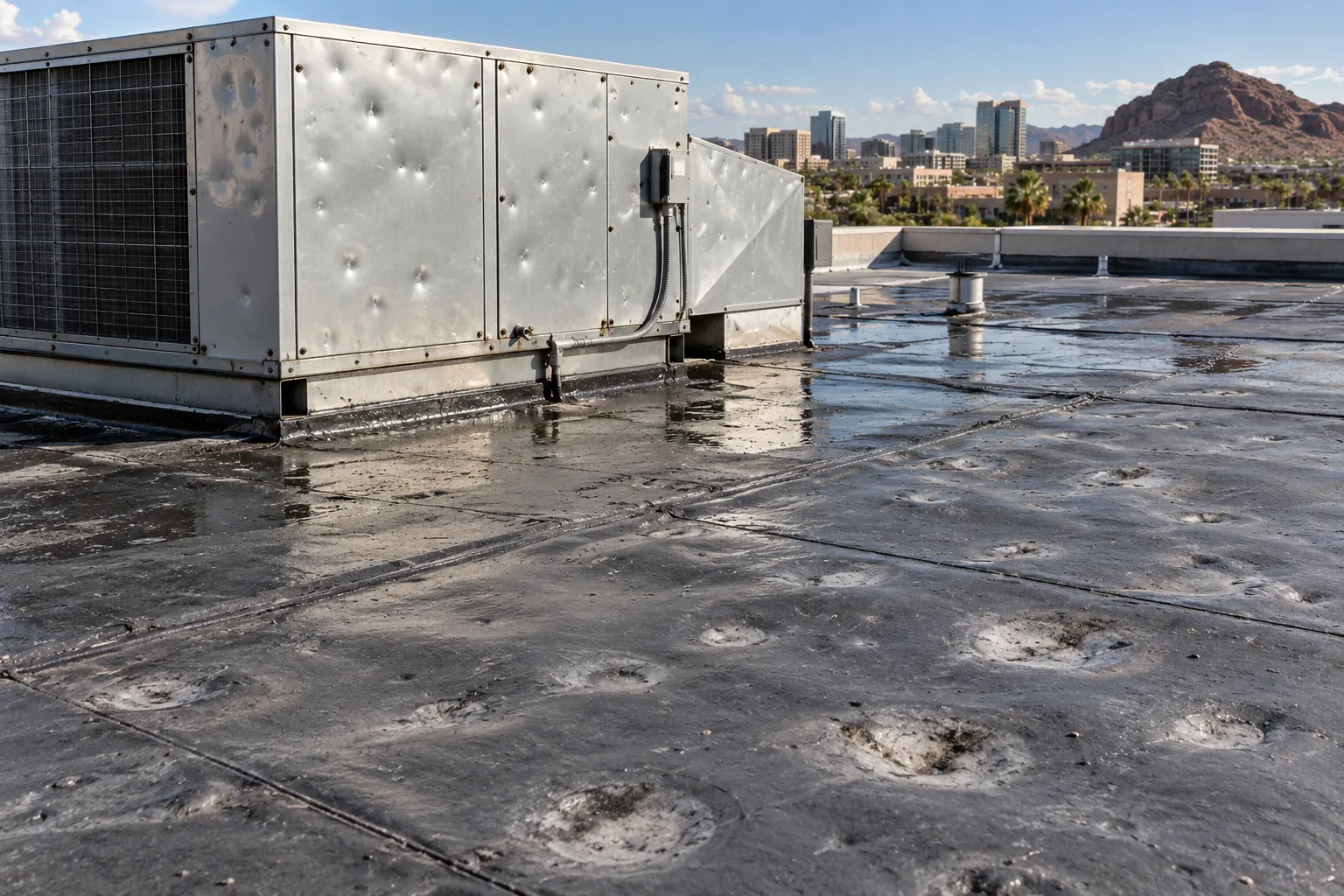
Heat, UV, and monsoon storms do most of the damage. Long stretches of direct sun dry out sealants and make older membranes brittle. The daily swing between hot afternoons and cooler nights flexes seams, fasteners, and flashing until they open.
The National Weather Service in Phoenix sets Arizona's monsoon season at June 15 through September 30, with dust, sudden downpours, and gusts that can peel back loose membrane edges and clog drains.
How should I document storm or wind damage on a commercial roof for insurance?
Start with photos before anything is moved, then call your insurer. The Arizona Department of Insurance and Financial Institutions advises recording damage quickly, keeping photos and receipts, and contacting the insurer before repairs begin.
- Photograph torn membrane, lifted edges, displaced panels, and clogged drains from several angles
- Capture interior ceiling stains and wet equipment with dates
- Keep receipts for tarps, cleanup, and any temporary patch
- Ask the roofer for an inspection report with marked-up roof photos
Permits, Taxes, And Rebates
Do commercial roof repairs in Tempe and nearby areas need a permit?
It depends on the scope of work and on which jurisdiction covers the address. Re-roofing and deck replacement are the jobs most likely to need a building permit, so ask the permit office before work starts. The office changes once a property crosses the Tempe city line.
| Area | Jurisdiction | Permit office |
|---|---|---|
| Tempe (citywide) | City of Tempe | Tempe Building Safety |
| Tempe Town Lake area | City of Tempe | Tempe Building Safety |
| Tempe Maker District | City of Tempe | Tempe Building Safety |
| Discovery District | City of Tempe | Tempe Building Safety |
| Guadalupe | Town of Guadalupe | Town Public Works |
| Ahwatukee Foothills | City of Phoenix | Phoenix Planning and Development |
| South Mountain | City of Phoenix | Phoenix Planning and Development |
Buildings on the Tempe Historic Property Register also go through the city's Historic Preservation Office for exterior changes, which can include visible roof edges, parapets, and rooflines.
Can a commercial roof project qualify for Section 179 in 2026?
Yes, in many cases. IRS Publication 946 lets roofs on existing nonresidential buildings count as qualified real property for Section 179. For tax years starting in 2026, the deduction limit is $2,560,000.
Roofs on residential rental property are excluded. A new membrane over a warehouse or a rebuilt metal roof section can fall under these rules, and your CPA should confirm how your roof work is treated.
Does SRP offer rebates for commercial roof work in Tempe?
Programs exist, but they change, so check before you plan around one. Your power bill shows which utility serves the building. SRP lists business energy-efficiency programs, including custom rebates, and their terms shift over time.
Cool roof programs often call for coatings or membranes rated in the Cool Roof Rating Council directory, so confirm the rating before a reflective coat goes on over patched seams.
Service Areas And Getting Started
What areas do you serve?
Tempe Commercial Roof Repair covers Tempe and six nearby areas.
- Citywide Tempe: older downtown flat roofs and freeway warehouses
- Guadalupe: its own town, with permits through Town Public Works
- Ahwatukee Foothills: retail and office roofs reached by I-10
- South Mountain: a Phoenix village under Phoenix permit rules
- Town Lake area (Tempe Lake): mid-rise roofs reached through roof hatches
- Maker District (Tempe Maker): Broadway industrial roofs full of exhaust fans
- Discovery District: tech buildings, dense air handlers, sensitive interiors
How do I get started?
Call us or request a free estimate to set up a free roof inspection. A crew walks the roof and the space under it, then explains in plain terms what needs repair now and what can wait. The inspection looks at:
- Seams, laps, and fasteners across the field
- Flashings at parapets, curbs, and skylights
- Drains and scuppers for blockage and ponding rings
- Insulation for trapped moisture
- Interior ceiling stains that point back to the entry point
Repair Pages And Sources
Each repair and area has its own page, and every outside fact above links to its source.
- Flat roof repair for Tempe offices and warehouses
- Repairing leaking commercial metal roofs
- Tracing and fixing commercial roof leaks
- Industrial roof repair around running equipment
- Commercial roof repair in Guadalupe
- Ahwatukee Foothills roof repair
- South Mountain commercial roof repair
- Roof repair near Tempe Town Lake
- Maker District industrial roof repair
- Discovery District lab and tech roof repair
- City of Tempe, Building Safety
- City of Tempe, Historic Preservation Design Review
- City of Tempe, Tempe Maker District / Broadway Innovation Hub
- City of Tempe, Innovation Hubs
- Town of Guadalupe
- City of Phoenix, Ahwatukee Foothills Village
- City of Phoenix, South Mountain Village
- City of Phoenix, Commercial Plan Reviews and Permits
- National Weather Service Phoenix, Monsoon Safety
- Arizona Department of Insurance and Financial Institutions, storm claim guidance
- IRS Publication 946
- SRP
- Cool Roof Rating Council, Rated Roof Products Directory
Still Have A Roof Question?
Call and ask it, or request a free estimate and we will answer it on the roof.